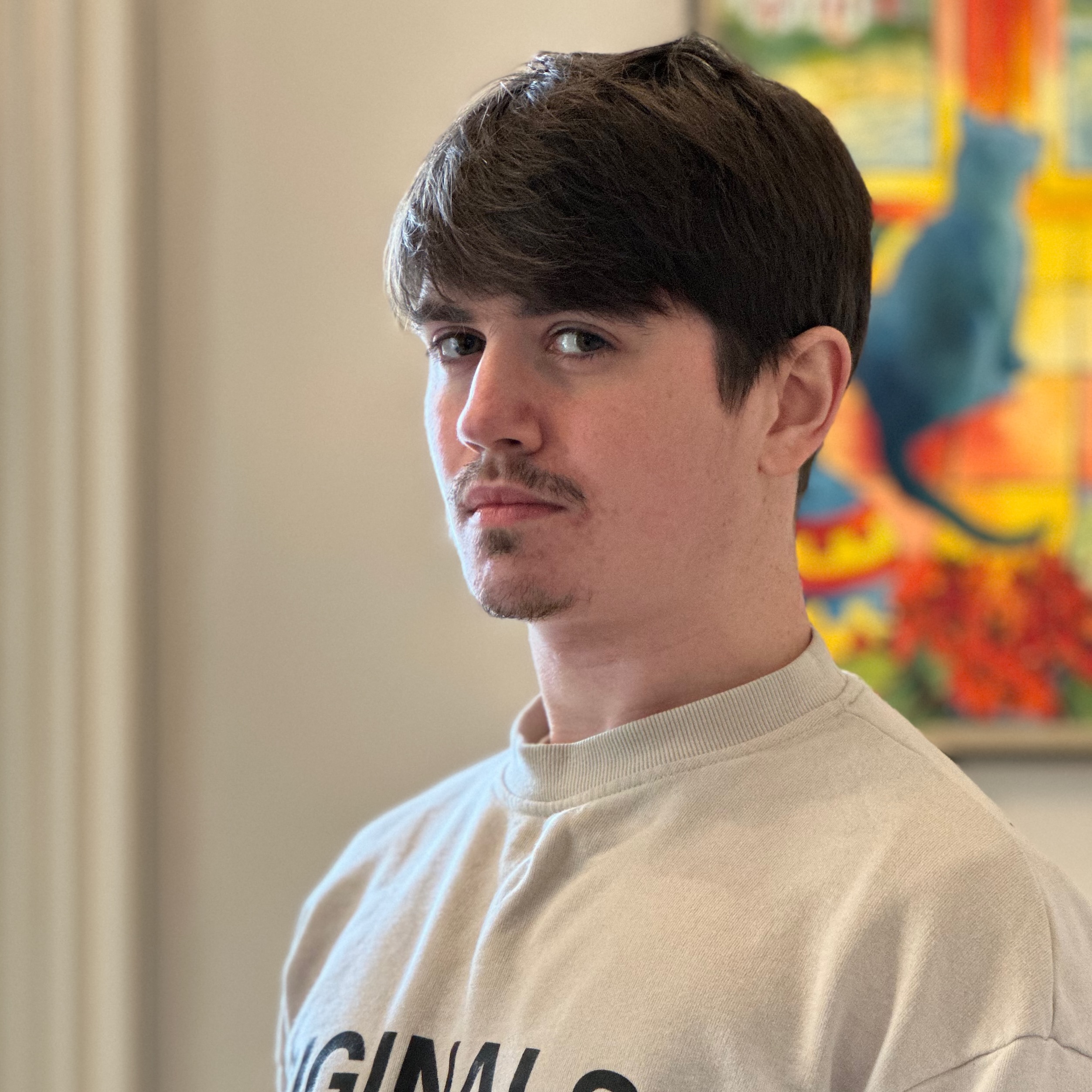
š Hello, Iām Cormac
I am Cormac Kinsella, a mathematician and software engineer completing my Masters in Mathematics with an Informatics Minor at the Technical University of Munich. My work focuses on the general intersection of differential geometry and probability theory, with additional research interests in tensor networks, quantitative finance, and linguistics. While my background is rooted in professional software engineeringāmost recently at the BMW Group developing numeric libraries and datahubsāI have recently pivoted toward applied mathematical theory. I now apply engineering rigor to rigorously define the stochastic and geometric structures that govern high-performance computation.
This transition allows me to bridge the gap between high-level abstraction and numerical stability. My industry experience in software engineering has provided me with a solid foundation in software architecture and automated testing. Today, I utilize that background to ensure theoretical breakthroughs (currently in manifold optimization and tensor algebra) remain computationally feasible and robust.
Feel free to reach out to me via email: cormac.c.00@gmail.com
š Geometry & Probability: The Foundation of Curved Optimization
Navigating complex, curved environments requires optimization algorithms that are inherently aware of the āshapeā of the data they process. By investigating the interaction between manifold theory and random processes, it is possible to design collective intelligence systems that do not rely on standard Euclidean techniques, which often falter in non-convex landscapes.
My central research involves Consensus-Based Optimization (CBO) on Riemannian Manifolds, where an ensemble of agents collaboratively identifies the global minimum of an energy functional on a curved surface. I move toward a Fixed Variance paradigm to understand the system as a stable statistical equilibrium shaped by the manifoldās geometry rather than a collapsing point. To ensure numerical integrity, I developed a perturbative theory that keeps discrete update laws geometrically consistent with continuous dynamics. In simple terms, imagine a group of scouts looking for the lowest valley in a mountain range; my work provides the mathematical āmapā that accounts for the earthās curvature so the group doesnāt get lost because they assumed the terrain was flat.
Note: I am unable to publish any of my research until around July 2026. If you would like to know more about what I am doing, please donāt hesitate to contact me!
šøļø Tensor Networks: Navigating the Curse of Dimensionality
High-dimensional systems often collapse under the weight of the āCurse of Dimensionality,ā where the state space grows exponentially with every new variable. Tensor networks resolve this by ācompressingā massive structures into manageable forms, allowing us to solve equations that would otherwise exceed the memory capacity of modern supercomputers.
I apply these insights to a QTT-HANK solver, which uses Quantized Tensor Trains (QTT) to solve macroeconomic models by reshaping grids into virtual binary modes. This reduces memory complexity from $O(N^d)$ to $O(d \cdot \log N \cdot r^2)$, enabling hyper-fine resolutions on standard hardware. This research integrates with my optimization work by treating economic states as points on a Product Stiefel Manifold (think of this as a set of all possible ways to choose a few perpendicular directions out of a much larger space). By navigating this manifold via Riemannian CBO, the solver maintains a low-rank structure while satisfying market-clearing constraints.
šøļø Quantum Physics: Applying abstract theories to software engineering solutions
I developed holographic_tn as a personal challenge to bridge the gap between high-level software engineering and abstract theories like the AdS/CFT correspondence. This ānumerical laboratoryā transforms complex hyperbolic geometries into interactive tools for simulating the quantum states defined upon them. By utilizing perfect tensors on hyperbolic tilings, I am able to investigate the holographic principle and the Ryu-Takayanagi formula in settings beyond simple lattices. In simpler terms, this āholographicā math is used by physicists to reconcile gravity with quantum mechanicsāfor instance, by treating the interior of a black hole like a 3D projection of the information stored on its 2D surface.
š Stochastic Modeling: High-Performance Quantitative Finance
Modern financial markets demand rigorous models that can account for āroughā volatility and the hierarchical properties of price paths. By viewing market dynamics through the lens of deep learning and stochastic differential equations (SDEs), we can compute accurate price bounds for complex derivatives in jagged, high-volatility environments.
I developed DeepQuant, a Python library for pricing American options using an adaptive deep learning framework. The library leverages the rough Bergomi model to capture market behavior where volatility is āroughā (Hurst parameter $H < 0.5$). The framework treats pricing as an optimal stopping problem, using path signaturesāhierarchical summaries of a pathās geometric propertiesāto approximate continuation values. By combining SDEs with deep ResNets, the solver yields a duality gap, which serves as a direct mathematical measure of pricing accuracy.
š¤ Future Interests: Geometric Machine Learning
Moving forward, I am focused on integrating my background in differential geometry into neural network and machine learning frameworks. I am particularly interested in applying geometric optimization to problems with poor convexity, where traditional gradient-based methods struggle. My goal is to work on projects involving robotics and computer vision, utilizing manifolds to improve the efficiency and stability of high-dimensional learning tasks.
š®šŖ Linguistics: Digital Preservation of Gaeilge
The preservation of minority languages requires the same structural dedication and technical integration as any mathematical research. Bringing native languages into the digital spaces where modern technology and gaming intersect is essential for ensuring a culture remains relevant in the future.
As a native Irish (An Ghaeilge) speaker, I have been involved in Gaeilge Chun Cinn, an initiative dedicated to translating apps, websites, and games into Irish. Our team successfully launched the official Irish translation for the blockbuster game Among Us (see our from The Verge here), coordinating an international team of volunteers to bring Gaeilge into the global gaming spotlight.
